Art in a Just Recovery: Reconnecting to Us
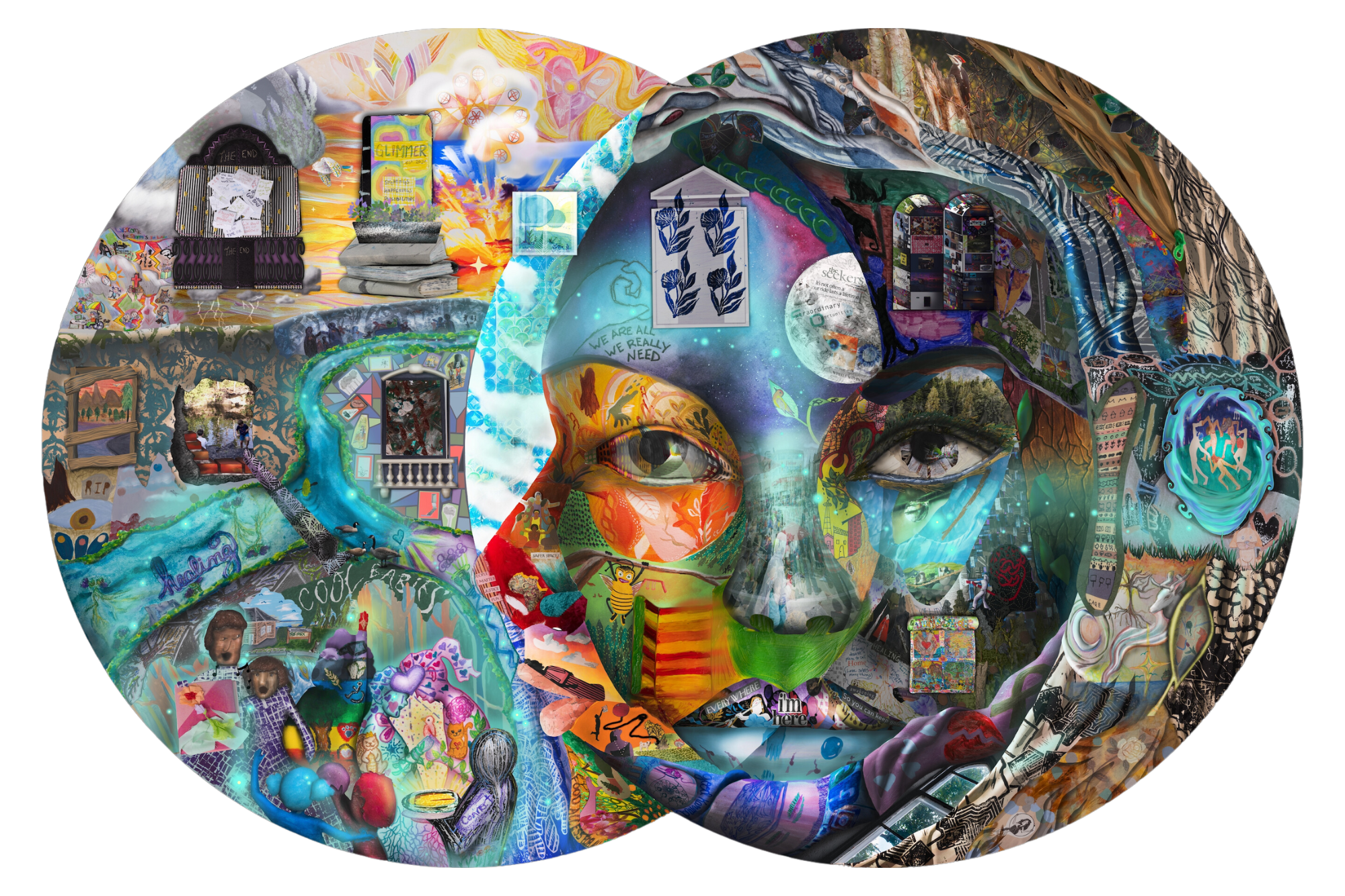
Art in a Just Recovery (AIJR) is a local community arts collaboration between Art Not Shame, the Guelph Neighbourhood Support Coalition, and Melanie Schambach that explores community care in the context of our ongoing pandemic recovery in Guelph. Through an eight week online community-engaged arts program, under the visionary leadership of social artist Melanie Schambach, community participants gathered for a series of online workshops to explore these ideas together. A series of in-person and online art-making workshops followed where participants were guided by Art Buddies in creating individual art pieces that came together to create the large-scale mural.
SOCIAL ARTIST LEAD: Melanie Schambach
Through social art, Melanie Schambach (she/they) invites the public to challenge the narratives of identity, belonging, and social transformation through participatory painting. As an Artivist Melanie acts against injustice and oppression by raising social and environmental awareness through participatory creative expression. Pushing the edges of one's imagination, Melanie's arts practice wants to mirror what evolution is possible.
For more on Melanie's work, visit here.
Over 70 participants from across Guelphs’ neighbourhoods had a hand in creating Art in a Just Recovery. Led by an amazing team of Art Buddies, community members came together and brought their stories, explored different art mediums, reflected on their experience through the stages of the Covid-19 pandemic, and connected with one another.
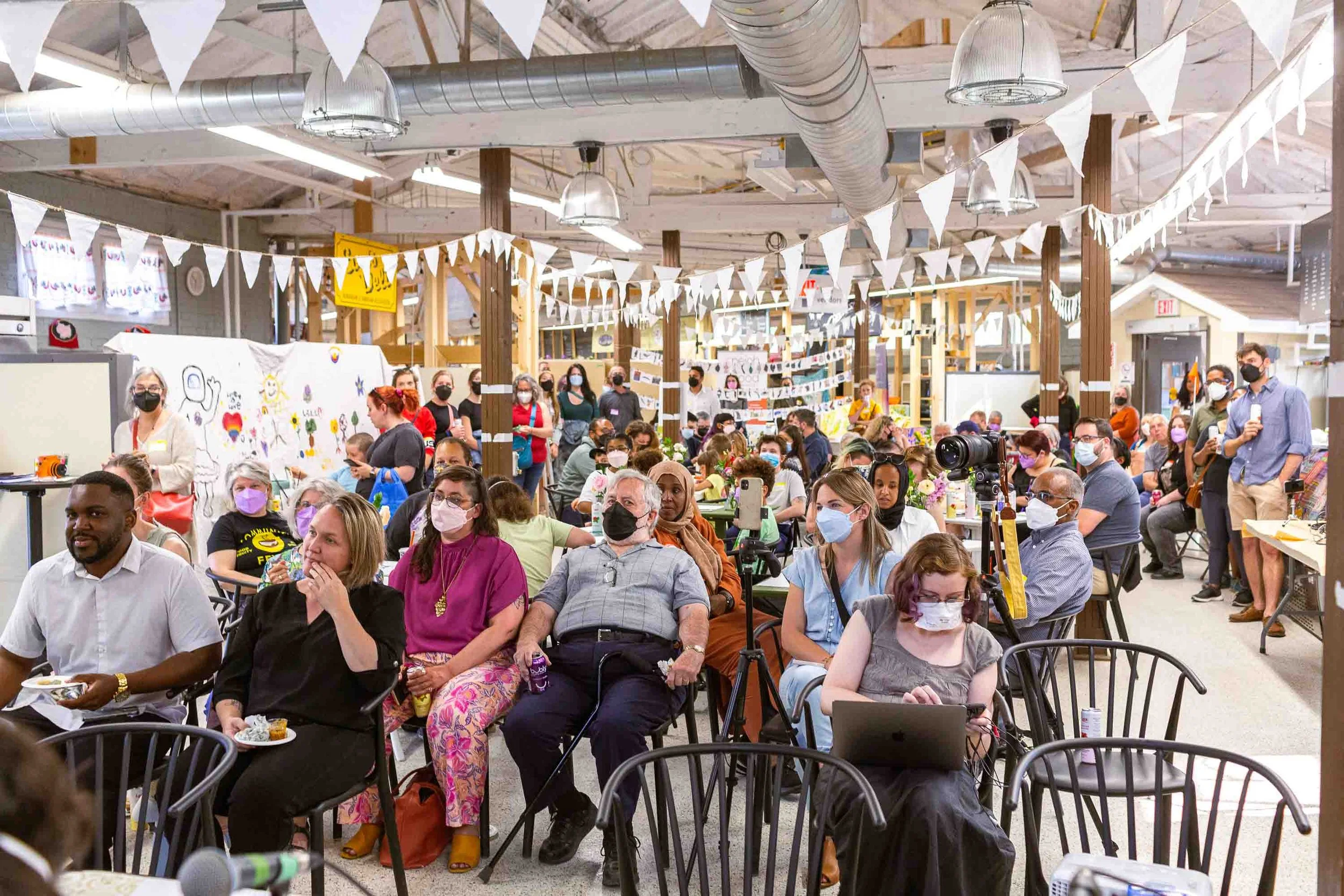
On June 7th, Art in a Just Recovery (AIJR) participants and community members gathered at the Guelph Farmers’ Market for an evening of beautiful live music from annais and raia, delicious bites from Community FEWD, individual art pieces from AIJR participants, a thoughtful panel discussion from three project participants, and the unveiling of the final mural.
The market was filled with laughs, tears, connection, hope, embraces, and community care.
Listen to the recording of the evening here. (CFRU)
We offer our deepest gratitude to the event sponsors and supporters:
Blooms & Flora who provided beautiful arrangements for the tables.
A generous donation from Skyline.
CFRU who recorded the entire event.
The Neighbourhood Group who provided gifts for participants and volunteers.
10C for coordination of the space for the mural to be hung.
Community Fewd for providing a delicious meal to those that attended.
AIJR Research Outputs
Building knowledge about community care and collective artmaking
Process
Alongside the Art in a Just Recovery Mural project, we conducted a community-engaged research project in partnership with the GNSC, social artist Melanie Schambach, community-engaged researcher Amy Kipp, and many of the artists and community members who took part in the mural project.Once the mural was unveiled in June 2023, we invited all those who had a hand in creating it to share about their experiences through a follow-up survey and conversation interviews. In total 28 people filled out the survey, and 18 participated in interviews where they shared the story behind the individual art piece they made as part of the mural, and their experiences making art with others. From what was shared, we built new knowledge about collective artmaking and community care.
Key ideas
Creating containers of care: Four themes emerged based on participants’ experiences during the mural project: 1) the importance participants placed on being able to come/go as they were, 2) the ability of collective artmaking to open them up socially and emotionally after the first two years of the pandemic, 3) the Mural Project’s impact beyond the collective artmaking workshops, as well as 4) moments where participants did not feel cared for during the project. These findings highlighted that when practiced with care collective artmaking can create a space (or ‘container’) of care in the city through which more caring worlds can be imagined and practiced in the here and now. Such spaces are important, but difficult to create, in a Canadian context where cities grapple with different ‘crises of care’ and funds to arts/cultural programming have been reduced.
Reimagining community care: Using art to explore Mural Project participants’ experiences of care during the pandemic illuminated care needs that surfaced in the city of Guelph. These needs resulted from increased isolation, job loss, precarious living situations, social unrest, illness, and disrupted services, among other factors. In some cases, people turned to existing forms of community care to meet their care needs; others accessed and/or helped create new forms of community care; while others, still, were unable to fully meet their needs. Finding, accessing, or creating new forms of community care in times of crisis can be difficult; as such, maintaining and continuing existing practices of community care is of utmost importance.
Sharing knowledge: This knowledge has been shared with different audiences, including through creative, community, and academic outputs as well as in other ways that are harder to pin down. The knowledge we co-created continues to circulate as we – those involved in the work – practice what we have learned in our everyday lives. You can access some of these resources below.
A more caring city of Guelph: Calls to care zineA creative display at the Live Work Well Research Centre’s Reimagining Livelihoods Forum
Art as we are: Creative community care, an exhibit at the Guelph Civic Museum
Collective artmaking and reimagining infrastructures of care in the city, a presentation at the International Geographical Congress
Curating with care: Exhibiting and programming sensitive subject matter in galleries and museums, a presentation as part of the “Nurturing a Space for Community Engagement” workshop hosted at Guelph Civic Museum
Practicing for more care-filled futures: Exploring the possibilities of collective artmaking, community care, and caring research praxis through research-creation, a PhD dissertation by Amy Kipp at the University of Guelph
Practicing for more carefilled futures - visual summaryAs we continue to share insights from the project, we will update this list, so check back in! To let us know how you use these resources, or to learn more, please contact Amy Kipp (akipp@uoguelph.ca).